RUDU CRM
An operating system for the sales day.
Carlos designed the architecture, operating logic and implementation of a prospecting CRM. Visual UI by Wallace Paulo; commercial need and reference model from Leonardo Gomes.
Implemented CRM · Enrichment and discovery planned
Architecture, system design, operating workflows and implementation
Context & challenge
RUDU CRM supports an internal B2B prospecting workflow: a daily queue, company and contact records, interactions, calendar, funnel, imports and analytics. Carlos translated the commercial need into the architecture and working system.
Sales work needs continuity between finding a company, recording contacts and interactions, and deciding the next action. Carlos defined the operating logic and implementation; the phased roadmap separates the implemented CRM from later automation.
My contribution
- Engineered
- Carlos created all architecture and system design, operating logic and platform implementation. He selected the TinyFish, DeepSeek and scraper strategy and planned its phased evolution.
- UI designer
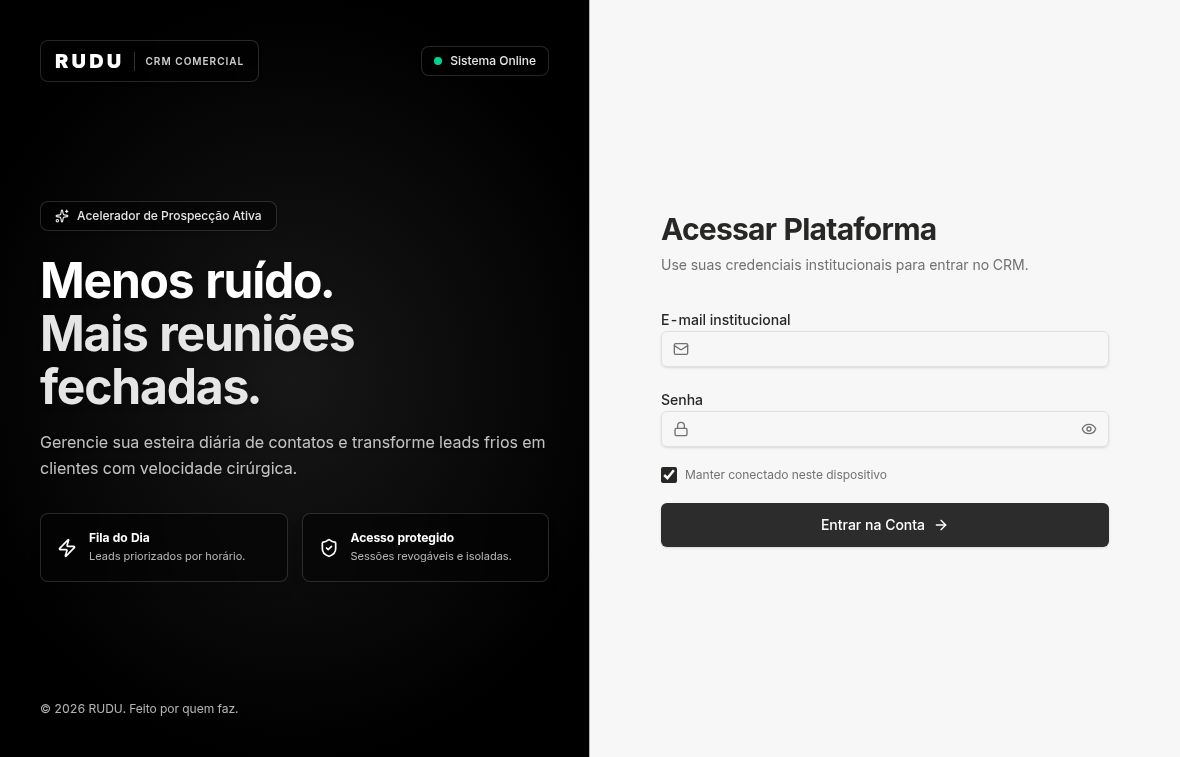
- Wallace Paulo created the visual UI from the supplied reference model. The displayed authentication layout is credited to him.
- Commercial input
- Leonardo Gomes brought the commercial need for prospect discovery and enrichment, together with a reference model.
Decisions & delivery
Build the working CRM first.
Phase 1 implements the standard CRM foundation: daily queue, company/contact records, interaction history, calendar, funnel, imports and analytics. The implementation uses Next.js, React and TypeScript, with Tailwind and Radix, Better Auth, Drizzle and Neon Postgres.
Make the operating logic explicit.
Carlos owned the system architecture and the workflow that connects records, daily follow-up and interactions. Wallace’s UI translates those flows into the visual interface, using Leonardo’s reference model.
Sequence automation by complexity.
Carlos’s planned phase 2 adds automatic enrichment using TinyFish and the DeepSeek API. Planned phase 3 adds automatic prospect discovery through scraping, followed by enrichment. Neither future phase is presented as an integrated capability.
What this work shows
This work shows Carlos’s contribution beyond the visible interface: turning a commercial requirement into system architecture, operating workflows and a functioning CRM, while crediting the designer of its UI.
Implemented scope is supported by a repository assessment and Carlos’s account. Only the public authentication page is shown; internal records and dashboards are omitted. Enrichment and automated prospect discovery remain planned. No measured sales growth, conversion results, delivery date or sole visual-design authorship is claimed.